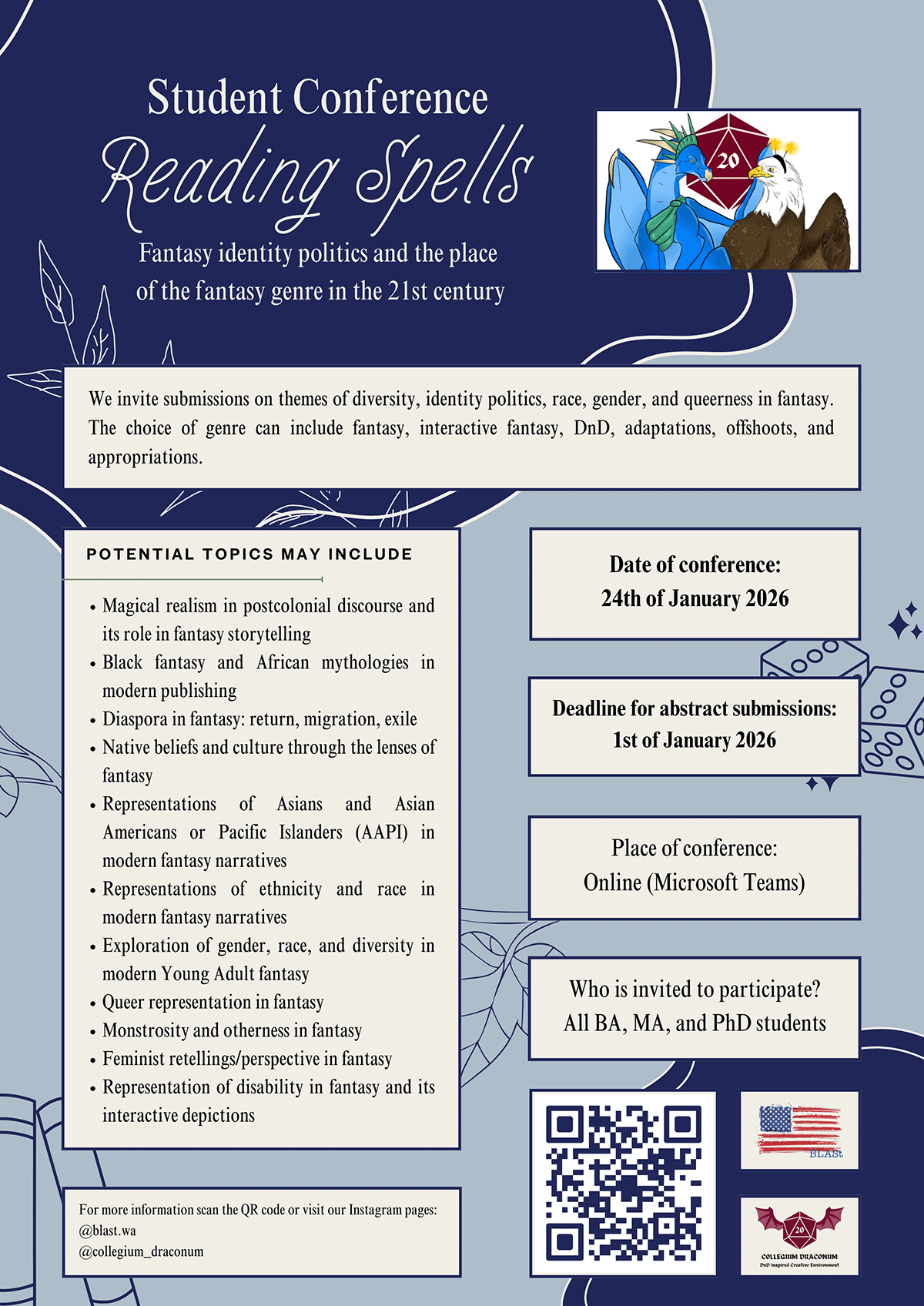
We invite submissions on themes of diversity, identity politics, race, gender, and queerness in fantasy. The choice of genre can include fantasy, interactive fantasy, DnD, adaptations, offshoots appropriations.
The conference is an online Teams event.
Deadline for submissions: 1 January 2026
Conference date: 24 January 2026
Contact persons: dr hab. Paweł Stachura, prof. UAM, Magdalena Szukalska, Marta Koprucka, Justyna Damec, and Aleksandra Binczarowska
Far from being removed into a separate world, fantasy has a range of themes and images that are directly related to contemporary social and political reality. By proposing a different order of reality, fantasy has a political impulse that can be variously identified as reformist, utopian, revolutionary, subversive, or satirical; this is the argument made by Rosemary Jackson in Fantasy: The Literature of Subversion (1981). Fantastic characters have been analysed in terms of their otherness, monstrosity, queerness, or racial difference, e.g. by Helen Young (2015) or by Richard Kearney (2003). But the impulse works both ways, as fantasy is rooted in its social and political background, as argued by Garcia (2017) or Yessler and Craig (2024) with reference to Dungeons and Dragons. We invite submissions on themes of diversity, identity politics, race, gender, and queerness in fantasy. The choice of genre can include fantasy, interactive fantasy, DnD, adaptations, offshoots, and appropriations
- Garcia, A. (2017). “Privilege, Power, and Dungeons & Dragons: How Systems Shape Racial and Gender Identities in Tabletop Role-Playing Games.” Mind, Culture, and Activity, 24(3), 232–246.
- Hassler-Forest, Dan. (2016). Science Fiction, Fantasy, and Politics. Rowman Littlefield.
- Jackson, Rosemary. (1981). Fantasy: The Literature of Subversion. Routledge.
- Little, Elizabeth. (2024). Understanding (Post)feminist Girlhood Through Young Adult Fantasy Literature. Routledge.
- Rayment, Andrew. (2014). Fantasy, Politics, Postmodernity: Pratchett, Pullman, Miéville and Stories of the Eye. Rodopi.
- Reid, Robin Anne. (2008). Women in Science Fiction and Fantasy. London: Bloomsbury Publishing.
- Yessler, R., & Craig, B. (2024). “Dungeons and Dragons: Gender, Race, and Power in the Fantasy and Storytelling Space.” GeoHumanities, 10(2), 463–471.
- Young, Helen. (2015). Race and Popular Fantasy Literature: Habits of Whiteness. Routledge.
- Tribunella Eric L. (2024). Reading Young Adult literature: A critical introduction. Peterborough: Broadview Press Ltd.
- Kovach, Margaret. 2010. Indigenous Methodologies: Characteristics, conversations, and contexts. Canada: University of Toronto Press.
- Kearney, Richard. (2003). Strangers, Gods and Monsters: Interpreting otherness. London: Routledge.
Potential topics may include:
- Magical realism in postcolonial discourse and its role in fantasy storytelling
- Black fantasy and African mythologies in modern publishing
- Diaspora in fantasy: return, migration, exile
- Native beliefs and culture through the lenses of fantasy
- Representations of Asians and Asian American or Pacific Islanders (AAPI) in modern fantasy narratives
- Representations of ethnicity and race in modern fantasy narratives
- Exploration of gender, race, and diversity in modern Young Adult fantasy
- Queer representation in fantasy
- Monstrosity and otherness in fantasy
- Feminist retellings/perspective in fantasy
- Representation of disability in fantasy and its interactive depictions
The QR code in the image points to this external link, which in turn resolves into this external link (to a page on Facebook) The external links to Instagram listed in the image are: