Time: Wednesday 13 May 2026 @ 10:00
Venue: Aula, Collegium Heliodori Święcicki, Grunwaldzka 6
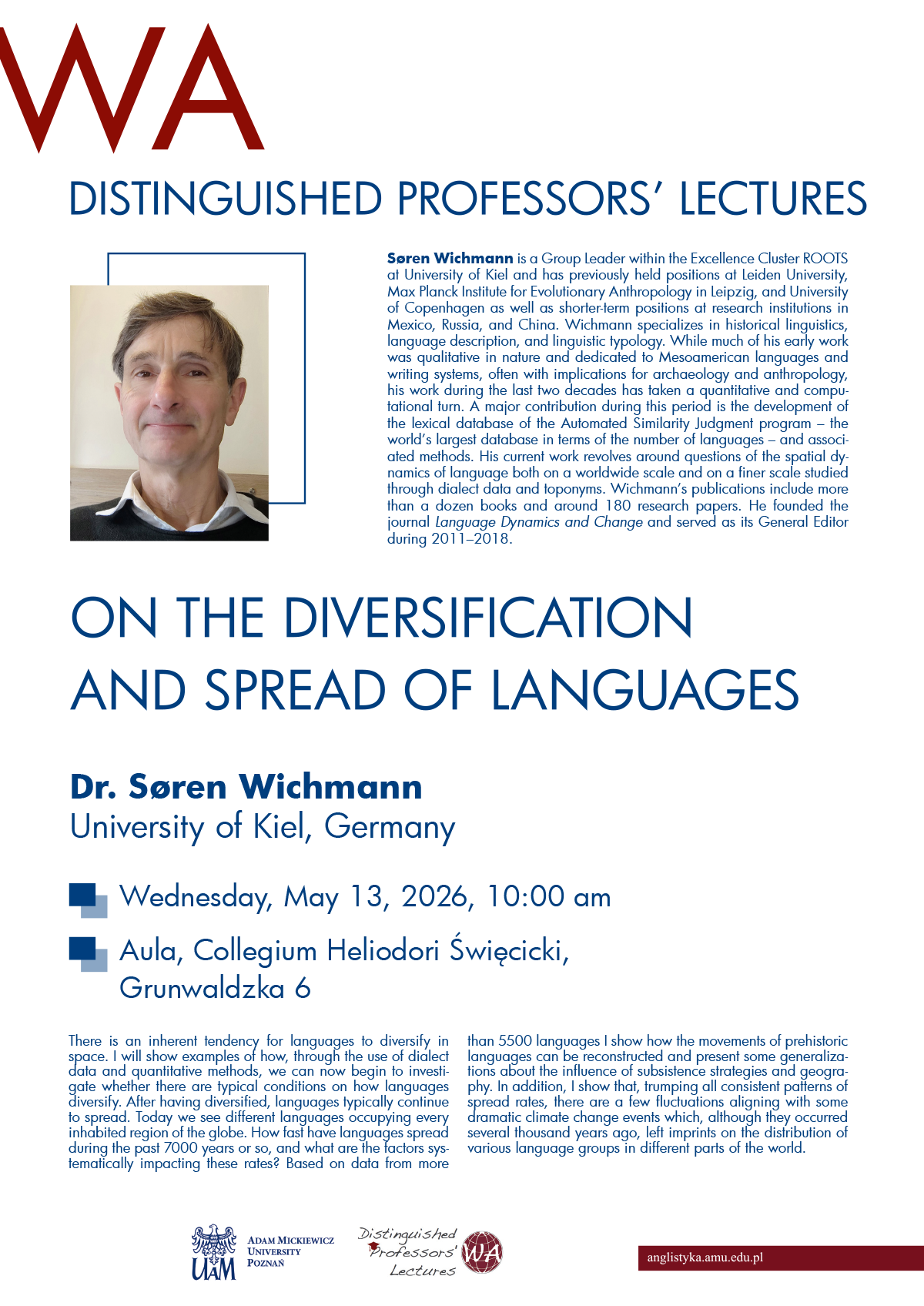
Speaker: Dr. Søren Wichmann (University of Kiel, Germany)
On the Diversification and Spread of Languages
Abstract
There is an inherent tendency for languages to diversify in space. I will show examples of how, through the use of dialect data and quantitative methods, we can now begin to investigate whether there are typical conditions on how languages diversify. After having diversified, languages typically continue to spread. Today we see different languages occupying every inhabited region of the globe. How fast have languages spread during the past 7000 years or so, and what are the factors systematically impacting these rates? Based on data from more than 5500 languages I show how the movements of prehistoric languages can be reconstructed and present some generalizations about the influence of subsistence strategies and geography. In addition, I show that, trumping all consistent patterns of spread rates, there are a few fluctuations aligning with some dramatic climate change events which, although they occurred several thousand years ago, left imprints on the distribution of various language groups in different parts of the world.
About the speaker
Søren Wichmann is a Group Leader within the Excellence Cluster ROOTS at University of Kiel and has previously held positions at Leiden University, Max Planck Institute for Evolutionary Anthropology in Leipzig, and University of Copenhagen as well as shorter-term positions at research institutions in Mexico, Russia, and China. Wichmann specializes in historical linguistics, language description, and linguistic typology. While much of his early work was qualitative in nature and dedicated to Mesoamerican languages and writing systems, often with implications for archaeology and anthropology, his work during the last two decades has taken a quantitative and computational turn. A major contribution during this period is the development of the lexical database of the Automated Similarity Judgment program – the world’s largest database in terms of the number of languages – and associated methods. His current work revolves around questions of the spatial dynamics of language both on a worldwide scale and on a finer scale studied through dialect data and toponyms. Wichmann’s publications include more than a dozen books and around 180 research papers. He founded the journal Language Dynamics and Change and served as its General Editor during 2011–2018.
About the lecture series
WA Distinguished Professors’ Lectures Series features internationally renowned scholars visiting the Faculty of English to share their research and professional expertise with the faculty and students.